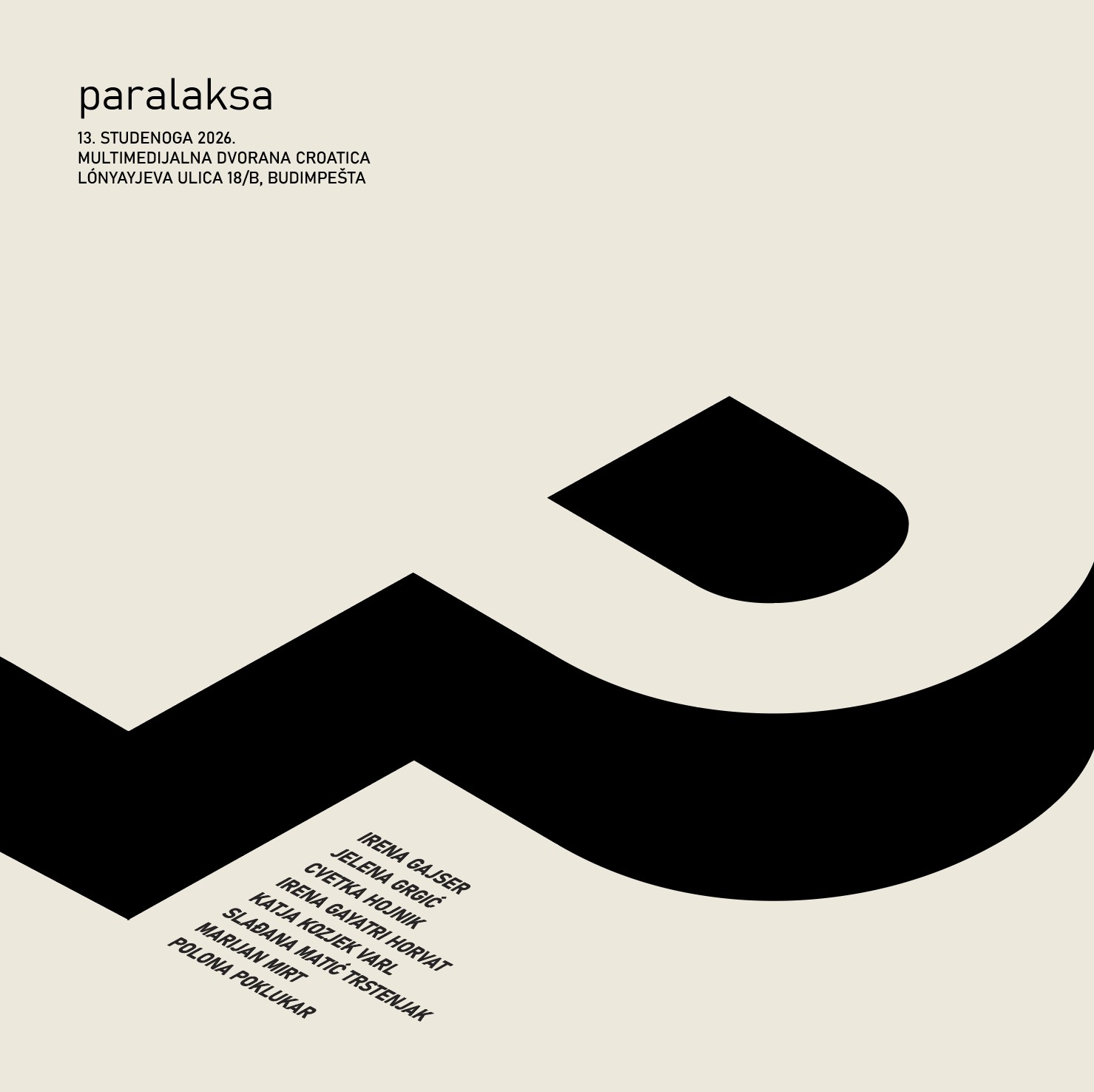
Parallax is the apparent shift in the position of an object that occurs when we change the point from which we observe it. The object remains the same, but what we see changes. The same is true of art. Our understanding of an artwork depends on the space, our experiences, and the perspective from which we approach it. This shift in perspective is the starting point of the exhibition Paralaksa, which presents artists associated with the Croatian Cultural Association in Maribor in Budapest.
The exhibition brings together diverse artistic approaches that have developed over the years within the Milena Lah Art Section. Painting, printmaking, photography, sculpture, and mixed media open up space for reflection on human beings, their surroundings, and memory. Some works explore colour, form, and material, while others draw on the human figure, nature, or the urban landscape. What connects them is neither a shared style nor a single theme, but rather the diversity of perspectives and modes of expression.
The exhibition presents works by Jelena Grgić, Irena Gajser, Irena Gayatri Horvat, Cvetka Hojnik, Katja Kozjek Varl, Slađana Matić Trstenjak, Marijan Mirt, and Polona Poklukar. Most of the artists are represented by individual works, primarily created during the Milena Lah Urban Art Colony, while Slađana Matić Trstenjak and Marijan Mirt present a broader selection of their recent artistic work. This selection brings together works produced over years of collective artistic activity with more recent artistic explorations, offering insight into different generations, experiences, and artistic approaches.
The Milena Lah Urban Art Colony has been held in Maribor since 2014, with its thirteenth edition scheduled to take place in 2026. Unlike art colonies that generally take place outside everyday surroundings, this one is held in the very centre of the city, at the premises of the Croatian Cultural Association in Maribor and at selected public locations. The city is therefore not merely the venue for the event but also becomes part of the creative process. The colony encourages encounters between artists of different generations and cultural backgrounds, the exchange of experiences, the creation of new works, and their presentation to the public.
The colony is named after the sculptor Milena Lah (1920–2003), who was born near Ajdovščina in Slovenia and whose life and artistic career connected the Croatian and Slovenian cultural spheres. She studied in Maribor and Zagreb and graduated in sculpture from the Academy of Fine Arts in Zagreb in 1949, under Vanja Radauš. Her biography reflects the very idea behind the colony: connecting places, people, and artistic experiences that extend beyond national borders.
The activities of the Milena Lah Art Section extend beyond individual exhibitions and artistic gatherings. They represent an ongoing process of artistic creation and connection among artists of different cultural backgrounds who live and work in Slovenia. Their collaboration does not imply a shared artistic language, but rather a creative space in which differences remain visible and each artist retains their individual artistic identity.
By being presented in Budapest, the works acquire a new spatial and cultural context. The artworks themselves remain unchanged, but the perspective from which we observe them shifts, opening up new possibilities for interpretation. This is precisely where the meaning of Paralaksa lies. Sometimes, all it takes is a change in our point of view to discover something new in what is already familiar.